Pearl Harbor by Steven M. Gillon
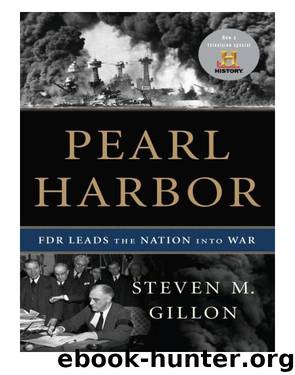
Author:Steven M. Gillon
Language: eng
Format: epub
Publisher: Basic Books
Published: 2011-10-05T04:00:00+00:00
10
“We are all in the same boat now”
ON SUNDAY EVENING, Winston Churchill was having dinner with the American ambassador to Britain, John G. “Gil” Winant, along with diplomat Averell Harriman and his future wife, Pamela. “The Prime Minister seemed tired and depressed,” Harriman recalled. “He didn’t have much to say throughout dinner and was immersed in his thoughts, with his head in his hands part of the time.”1
There was plenty of reason for gloom. For most of the year, as Nazi bombs rained down on London, Churchill’s top priority was to convince Roosevelt to enter the war. To his dismay, he had managed to wrangle old ships and other material but few commitments from the frustratingly elusive Roosevelt.
The two men had started a correspondence in September 1939 when Churchill joined the cabinet as the first lord of the admiralty. Churchill sent a series of letters about the problems confronting the British navy. On May 10, 1940—the day that Hitler invaded Belgium, the Netherlands, Luxembourg, and France—Churchill became prime minister, and the correspondence became more frequent, and more urgent. On May 15, he promised to fight alone, but if the United States did not intervene, he warned Roosevelt, “You may have a completely subjugated, Nazified Europe established with astounding swiftness, and the weight may be more than we can bear.”2
Roosevelt was not sure about his new counterpart. Although they came from similar social backgrounds and possessed a flair for the dramatic, Churchill was a political conservative who dreamed of preserving the British Empire. His love of alcohol, and capacity for consuming it, was legendary. “I suppose Churchill was the best man England had,” FDR told his cabinet on hearing the news that he was the new prime minister, “even if he was drunk half of his time.”3
In January 1941, Roosevelt had sent Harry Hopkins to London as his personal emissary to get a better sense of Churchill. “I suppose you could say—but not out loud—that I’ve come to try to find a way to be a catalytic agent between two prima donnas,” Hopkins told CBS correspondent Edward R. Murrow, who was in London at the time. Hopkins spent twelve evenings with Churchill, traveled with him to military posts, and came away inspired by Churchill’s determination and statesmanship. “People here are amazing from Churchill down,” he wrote FDR, “and if courage alone can win—the result will be inevitable. But they need our help desperately.”4
The frail, businesslike Hopkins was a big hit with Churchill as well. Interior Secretary Harold Ickes noted, “Apparently the first thing that Churchill asks for when he gets awake in the morning is Harry Hopkins, and Harry is the last one he sees at night.” Hopkins lobbied for more aid, but Roosevelt remained cautious. While declaring that America “must become the great arsenal of democracy,” he refused to give Churchill what he needed most—a declaration of war against Germany and American troops on European soil.
Over the next few months, Churchill continued to write as many as two or three letters a week to Roosevelt, describing Britain’s plight and pleading for American intervention.
Download
This site does not store any files on its server. We only index and link to content provided by other sites. Please contact the content providers to delete copyright contents if any and email us, we'll remove relevant links or contents immediately.
| Africa | Americas |
| Arctic & Antarctica | Asia |
| Australia & Oceania | Europe |
| Middle East | Russia |
| United States | World |
| Ancient Civilizations | Military |
| Historical Study & Educational Resources |
Cat's cradle by Kurt Vonnegut(15279)
Pimp by Iceberg Slim(14451)
4 3 2 1: A Novel by Paul Auster(12345)
Underground: A Human History of the Worlds Beneath Our Feet by Will Hunt(12064)
The Radium Girls by Kate Moore(11990)
Wiseguy by Nicholas Pileggi(5727)
The Fire Next Time by James Baldwin(5399)
Perfect Rhythm by Jae(5372)
American History Stories, Volume III (Yesterday's Classics) by Pratt Mara L(5281)
Paper Towns by Green John(5150)
Pale Blue Dot by Carl Sagan(4969)
A Higher Loyalty: Truth, Lies, and Leadership by James Comey(4927)
The Mayflower and the Pilgrims' New World by Nathaniel Philbrick(4466)
The Doomsday Machine by Daniel Ellsberg(4464)
Killers of the Flower Moon: The Osage Murders and the Birth of the FBI by David Grann(4419)
The Sympathizer by Viet Thanh Nguyen(4360)
Too Much and Not the Mood by Durga Chew-Bose(4309)
The Borden Murders by Sarah Miller(4288)
Sticky Fingers by Joe Hagan(4158)
